|
Material
|
Features
|
Common Grades
|
|
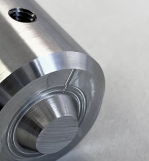 Hardened Steel Hardened Steel
|
High hardness and wear resistance, typically requiring grinding for precision finishing after heat treatment.
|
D2, H13, SKD11, 52100
|
|
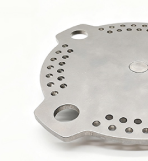 Stainless Steel Stainless Steel
|
Prone to work hardening and heat buildup, making grinding suitable for achieving high surface quality.
|
304, 316, 420, 440C
|
|
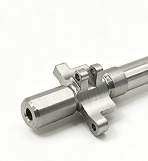 Alloy Steel Alloy Steel
|
High strength and heat-treatable, often ground to achieve final tolerances after hardening.
|
4140, 4340, 8620
|
|
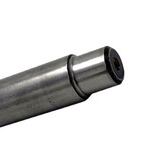 Tool Steel Tool Steel
|
Extremely hard and wear-resistant, relying on grinding for accurate and fine surface finishes.
|
P20, M2, H13
|
|
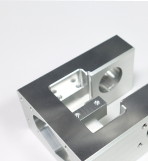 Aluminum Alloy Aluminum Alloy
|
Soft and easy to machine, with grinding used only for high-precision or fine surface requirements.
|
6061, 7075
|
|
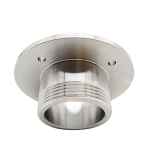 Titanium Titanium
|
High strength with poor thermal conductivity, where grinding helps improve surface integrity and accuracy.
|
Ti-6Al-4V
|
Types of CNC Grinding Services
Different part geometries and precision requirements call for different grinding methods. Selecting the correct process helps achieve the required dimensions, surface finish and production efficiency.
Surface Grinding
Surface grinding produces flat, smooth and parallel surfaces on plates, blocks, fixtures, mold components and machine parts. It is commonly used as a finishing operation after milling or heat treatment.
Cylindrical Grinding
Cylindrical grinding finishes the external diameter of round components such as shafts, pins, rollers and spindles. It is suitable for parts requiring accurate diameter, roundness, concentricity and surface finish.
Internal Grinding
Internal grinding is used to finish bores, bearing seats and internal cylindrical surfaces. It is often selected for components requiring precise internal diameters, close fits or accurate alignment between internal and external features.
Centerless Grinding
Centerless grinding removes material from cylindrical parts without holding them between centers. It is suitable for producing pins, rods, shafts and other round parts in repeat quantities with consistent diameter and surface quality.
Precision Form Grinding
Form grinding creates specific profiles, contours, grooves or angled surfaces using a shaped grinding wheel. It is commonly applied to tooling, mold inserts, gauges and complex precision components.
When Should You Use Precision CNC Grinding Service?
CNC grinding services are generally selected when conventional milling or turning cannot achieve the required dimensional accuracy, surface finish or geometric control.
Grinding may be suitable when a part requires:
- Final machining after heat treatment
- Precise bearing or shaft fits
- Improved flatness, roundness or parallelism
- Fine sealing or contact surfaces
- Controlled external or internal diameters
- Reduced runout and concentricity error
- Smooth surfaces with minimal machining marks
- Consistent dimensions across repeat production
Grinding is usually a finishing process rather than a bulk material-removal method. Parts are commonly rough-machined close to their final dimensions before the grinding operation.
CNC Grinding Applications
Precision CNC grinding is widely used for components that require accurate dimensions, smooth surfaces and reliable fit with mating parts.
Automotive Components
Common applications include transmission shafts, valve components, bearing seats, gear components, pins and precision engine parts.
Aerospace Components
Precision CNC grinding can be used for shafts, bushings, hydraulic components, tooling and other parts requiring close dimensional control and consistent surface integrity.
Robotics and Automation
Precision-ground components include guide shafts, locating pins, actuator parts, fixture plates and motion-control components.
Mold and Tooling
Grinding is commonly used to finish mold inserts, core pins, ejector pins, slide rails, punches, dies and precision tooling components.
Industrial Equipment
Typical parts include spindles, rollers, machine shafts, bearing housings, hydraulic components and precision fixtures.
Request Precision CNC Grinding Services