|
Material
|
Features
|
Common Grades
|
|
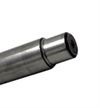 Tool & Die Steel Tool & Die Steel
|
High hardness (58–65 HRC), wear-resistant, heat-treatable — retains sharp edges and dimensional stability under repeated impact and pressure.
|
D2, H13, SKD11, P20, S136
|
|
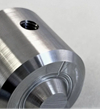 Hardened Alloy Steel Hardened Alloy Steel
|
Through-hardenable, high tensile strength, good fatigue resistance — maintains mechanical properties under sustained load and cyclic stress.
|
4140, 4340, 52100
|
|
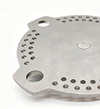 Stainless Steel Stainless Steel
|
Corrosion-resistant, non-magnetic options available, good surface finish compatibility — suitable for food, medical, and marine environments.
|
304, 316, 17-4PH, 440C
|
|
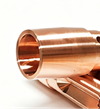 Copper & Brass Copper & Brass
|
High electrical and thermal conductivity, good corrosion resistance, excellent machinability — standard for conductive and fluid-handling components.
|
T2, H62, beryllium copper
|
|
 Inconel Inconel
|
Retains strength at high temperature (up to 1,090°C), oxidation and corrosion resistant — the standard for extreme thermal and chemical environments.
|
Inconel 718
|
Applications of Wire EDM Machining
Mold & Die Industry
- Injection mold components
- Punches and dies
- Precision inserts
Automotive Industry
- Automotive precision parts
- Tooling components
- Prototype components
Medical Industry
- Surgical components
- Medical device parts
Automation & Machinery
- Fixtures
- Precision mechanical parts
- Custom components
Wire EDM vs. CNC Milling
Wire EDM and CNC milling are both precision machining methods used for manufacturing complex metal parts. However, they use different cutting principles and are suitable for different applications.
Wire EDM uses electrical discharge energy to cut electrically conductive materials without direct tool contact, making it ideal for hardened materials, intricate profiles, and tight-tolerance components.
CNC milling uses rotating cutting tools to remove material mechanically, offering high efficiency for general machining, 3D shapes, pockets, holes, and larger production requirements.
Choosing between Wire EDM and CNC milling depends on factors such as material hardness, part geometry, tolerance requirements, surface finish, and production volume.
| Comparison |
Wire EDM |
CNC Milling |
| Machining Method |
Electrical discharge cutting using a thin wire electrode |
Mechanical cutting using rotating tools |
| Contact With Workpiece |
No direct contact |
Direct tool contact |
| Suitable Materials |
Conductive materials such as tool steel, stainless steel, copper, brass, aluminum |
Most metals and plastics including aluminum, steel, stainless steel, plastics |
| Material Hardness |
Excellent for hardened materials after heat treatment |
Limited by tool hardness and cutting conditions |
| Accuracy |
Extremely high precision for complex parts and tight tolerances |
High precision with flexible machining capability |
| Complex Shapes |
Excellent for narrow slots, sharp corners, intricate profiles |
Suitable for 3D contours, pockets, holes, and general machining |
| Cutting Force |
Almost no cutting force, reducing deformation risk |
Higher cutting force may affect thin or delicate parts |
| Surface Finish |
Excellent surface quality with fine finishing options |
Depends on tools, speed, feed rate, and machining conditions |
| Production Efficiency |
Better for complex precision parts |
Generally faster for larger material removal |
| Typical Applications |
Dies, molds, precision inserts, punches, medical parts |
Machine parts, housings, brackets, prototypes, structural components |
Which Machining Method Should You Choose?
Choose Wire EDM Services when your project requires:
● Tight dimensional tolerances
● Complex internal profiles or narrow slots
● Hardened steel or difficult-to-machine conductive materials
● Minimal deformation during machining
● High-precision mold and tooling components
Choose high precision cnc milling when you need:
● Faster material removal
● Large or complex 3D components
● General precision machining
● Higher production efficiency for larger parts
For many precision manufacturing projects, Wire EDM and CNC milling are complementary processes. CNC milling can be used for rough machining and general features, while Wire EDM provides the final high-precision cutting for critical areas requiring tight tolerances.
Keywin provides both precision Wire EDM Services and CNC machining solutions to support prototypes, custom components, and production manufacturing requirements.