Process Principle + Advantages
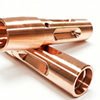
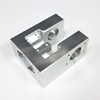
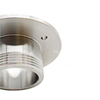
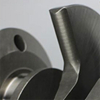
Milling is a machining method that uses rotating tools to remove material layer by layer. Tools can move flexibly under multi-axis coordination to achieve high-precision forming of complex structures and intricate contours. Depending on processing requirements, three-axis, four-axis, or five-axis milling can be employed to efficiently complete tasks ranging from flat surfaces to complex curved surfaces, offering high precision, stability, and excellent repeatability. We support 3-axis, 4-axis, and 5-axis machining to meet the manufacturing demands of complex parts and high-precision structural components.
-
![]()
3-Axis Milling
The tool moves along the X, Y, and Z axes for cutting, representing the most fundamental structure.
Suitable for flat surfaces, grooves, holes, and simple curved parts.
Achieves accuracy up to ±0.01 mm at low cost
-
![]()
5-Axis Milling
In addition to X, Y, and Z axes, the tool incorporates two rotational axes for cutting at any angle.
Suitable for complex surfaces, deep cavities, and irregular structures.
Achieves accuracy up to ±0.005 mm in a single setup.