|
Metals
|
Characteristics
|
Common Grades
|
|
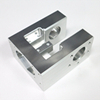 Aluminum Alloys Aluminum Alloys
|
Lightweight, excellent machinability, and superior surface treatment compatibility.
|
6061, 7075, 5052, 2024, 6082, 6063, 2011, 5083, MIC6.
|
|
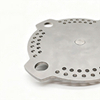 Stainless Steel Stainless Steel
|
High corrosion resistance, exceptional strength, and long-term stability.
|
303, 304, 316, 17-4PH,Duplex 2205
|
|
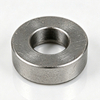 Carbon Steel Carbon Steel
|
High strength, stable processing, and excellent cost-efficiency.
|
1045 (45#), 1020,A36 (Q235), Q345.
|
|
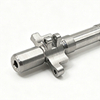 Alloy Steel Alloy Steel
|
Wear-resistant, high fatigue strength, and optimized mechanical properties post-heat treatment.
|
4140, 4340, D2, M2.
|
|
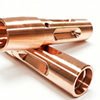 Brass Brass
|
Excellent machinability, corrosion resistance, and high dimensional precision.
|
C360, C260, C280.
|
|
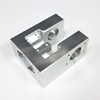 Zinc Alloys Zinc Alloys
|
Excellent fluidity, cost-effective, and ideal for precision aesthetic components.
|
Zamak 3 (Standard), Zamak 5 (High Strength), Zamak 2 (Wear Resistant),
|
|
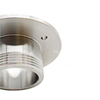 Titanium Alloys Titanium Alloys
|
High strength-to-weight ratio, superior corrosion resistance, and lightweight (high machining difficulty).
|
Ti-6Al-4V (Grade 5), Grade 2 (CP).
|
|
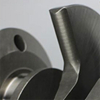 Inconel Inconel
|
High-temperature resistance, corrosion resistance, and fatigue resistance; engineered for high-strength parts in extreme environments.
|
Inconel 718
|
|
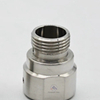 Invar36 Invar36
|
Extremely low coefficient of thermal expansion (CTE) at room temperature, excellent dimensional stability, and good ductility. It maintains nearly constant dimensions even during temperature fluctuations.
|
Invar36
|
Prototype and Production Precision CNC Turning
Our precision CNC turning services support one-off prototypes, engineering samples, low-volume production and repeat manufacturing. Prototype production helps verify part fit, function and manufacturability before moving into larger quantities. For repeat orders, CNC machining programs, tooling arrangements and inspection requirements can be retained to improve consistency and lead-time control.
Types of Precision CNC Turning Operations
CNC precision turning includes several machining operations used to create different shapes, dimensions and functional features on rotational components. The most common precision CNC turning operations include:
Straight Turning
Straight turning reduces the outside diameter of a rotating workpiece. The cutting tool moves parallel to the workpiece axis, removing material evenly along its length. This operation is commonly used to manufacture shafts, pins, rods and hydraulic components.
Taper Turning
Taper turning produces a gradual change in diameter by moving the cutting tool at an angle to the workpiece axis. It is suitable for manufacturing conical components such as machine handles, alignment pins, tool holders and tapered shafts.
Grooving
Grooving creates narrow channels or recessed sections on the internal or external surface of a part. These grooves may be used for snap rings, seals, O-rings, assembly positioning or clearance between mating components.
Facing
Facing removes material from the end of a rotating workpiece to produce a flat, smooth and dimensionally accurate surface. It is often performed to establish the final part length or prepare the workpiece for additional machining operations.
Threading
Threading creates precise internal or external screw threads on turned components. CNC lathes can manufacture metric, UNC, UNF, NPT, BSP and other standard or custom thread profiles for bolts, fittings, connectors, housings and mechanical assemblies.
Precision CNC Turning Applications and Industries
Precision CNC turning is widely used to manufacture cylindrical and rotational components for both everyday products and demanding industrial equipment. Its ability to achieve consistent dimensions, tight tolerances and smooth surface finishes makes it suitable for a broad range of applications.
Automotive
CNC turning is used to produce shafts, bushings, pins, sleeves, fittings and transmission components that must withstand repeated movement, friction and torque.
Aerospace
Aerospace applications require lightweight, accurate and highly reliable components. CNC-turned parts commonly include couplings, nozzles, fasteners, spacers and hydraulic system components.
Medical
Precision turning supports the production of surgical instruments, implant components, connectors and equipment housings where dimensional accuracy, surface quality and material traceability are critical.
Electronics
CNC precision turning is commonly used for connectors, terminals, sensor housings, threaded inserts and enclosures made from aluminum, brass, copper and other non-ferrous metals.
Send us your drawings, material requirements and order quantity for a professional manufacturability review and quotation.Get Precision CNC Turned Parts for Your Project